
As I’ve mentioned in a previous blog post, I’ve been diagnosed with ADHD. Many people associate that with hyperactive kids, usually boys. But it often presents itself quite differently in girls and women.

The hyperactivity can be internal. For me, it’s a racing mind where thoughts overlap like tangled threads, and an internal dialogue that never switches off. It’s almost like having a radio playing constantly, sometimes it’s words, sometimes it’s songs, sometimes it’s just noise. There’s never true silence; there’s always something happening in the background of my brain.
Now imagine having that internal noise all the time, while also hearing everything going on around you, every conversation, every click of a keyboard, even the hum of electricity. Your brain can’t filter any of it out. The same goes for what you see: every movement, every flicker, every detail demands attention.
Then picture sitting at a desk in an open office. You’re trying to focus on one task, but you hear people talking, laughing, moving around, printers whirring. A colleague comes to ask you a question, and you try to focus on their words, but your mind drifts, a part of you is still processing their first sentence, another part is tracking a phone ringing nearby. By the time you snap back, you’ve missed half of what they said. The task you were working on? Gone from memory. Focus? Scattered.
That’s just a small glimpse into how ADHD affects my work life every day, and no one can see how hard I’m trying to focus, how much energy it takes to fight against both the noise around me and the constant commentary inside my head.
A lot of people seem to think ADHD is something you “grow out of” Spoiler alert, you don’t! It just changes character as you grow. Many of us learn to mask our symptoms to appear socially acceptable, but that doesn’t mean they disappear.
Of course, ADHD is just one part of the much broader neurodiversity spectrum. It also includes Autism, Anxiety disorders, Schizophrenia spectrum conditions, Dyslexia, Tourette’s Syndrome, Dyscalculia, OCD, Bipolar Disorder, Epilepsy, Traumatic Brain Injury, and many more.
But here’s the important part: neurodivergence isn’t about brokenness or deficit. It’s about recognizing that human brains are naturally diverse and that our workplaces are too often built for only one kind of brain.
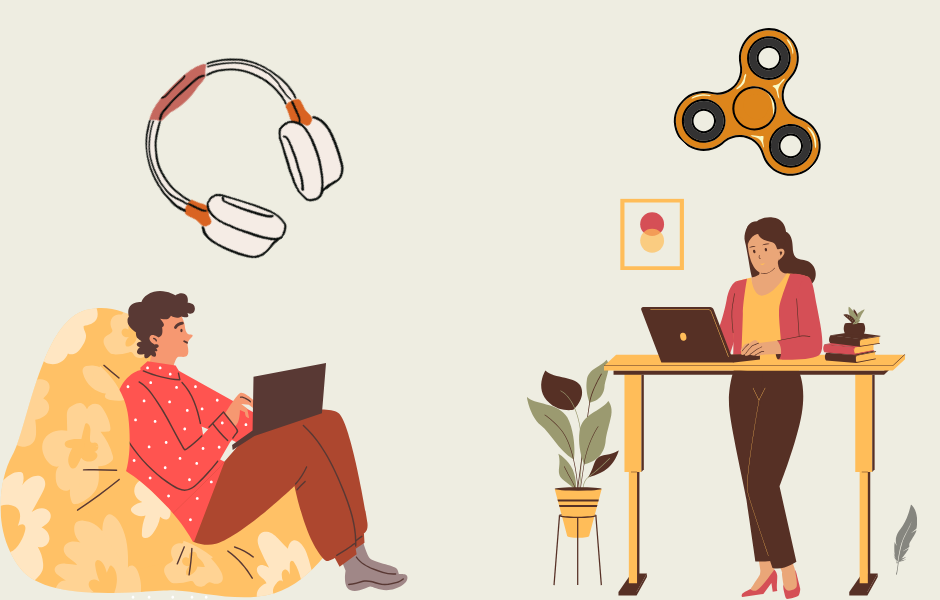
I’m not sharing my experiences for sympathy, but for understanding. Neurodivergent people aren’t asking for special treatment, just environments that recognize we don’t all think or work the same way. Small changes, like quieter spaces, flexible focus time, fidget tools, permission to work with headphones on or simply clearer communication, can make a huge difference.
Most of all, it’s about awareness and empathy, remembering that the person next to you might be fighting a battle inside their own head while still doing their very best to show up and do their work with diligence.
The more we learn to design for different minds, the more creative, compassionate, and effective our workplaces can become.

Leave a Reply